Wired for Motion
Neuroanatomical Portrait
This project in short…
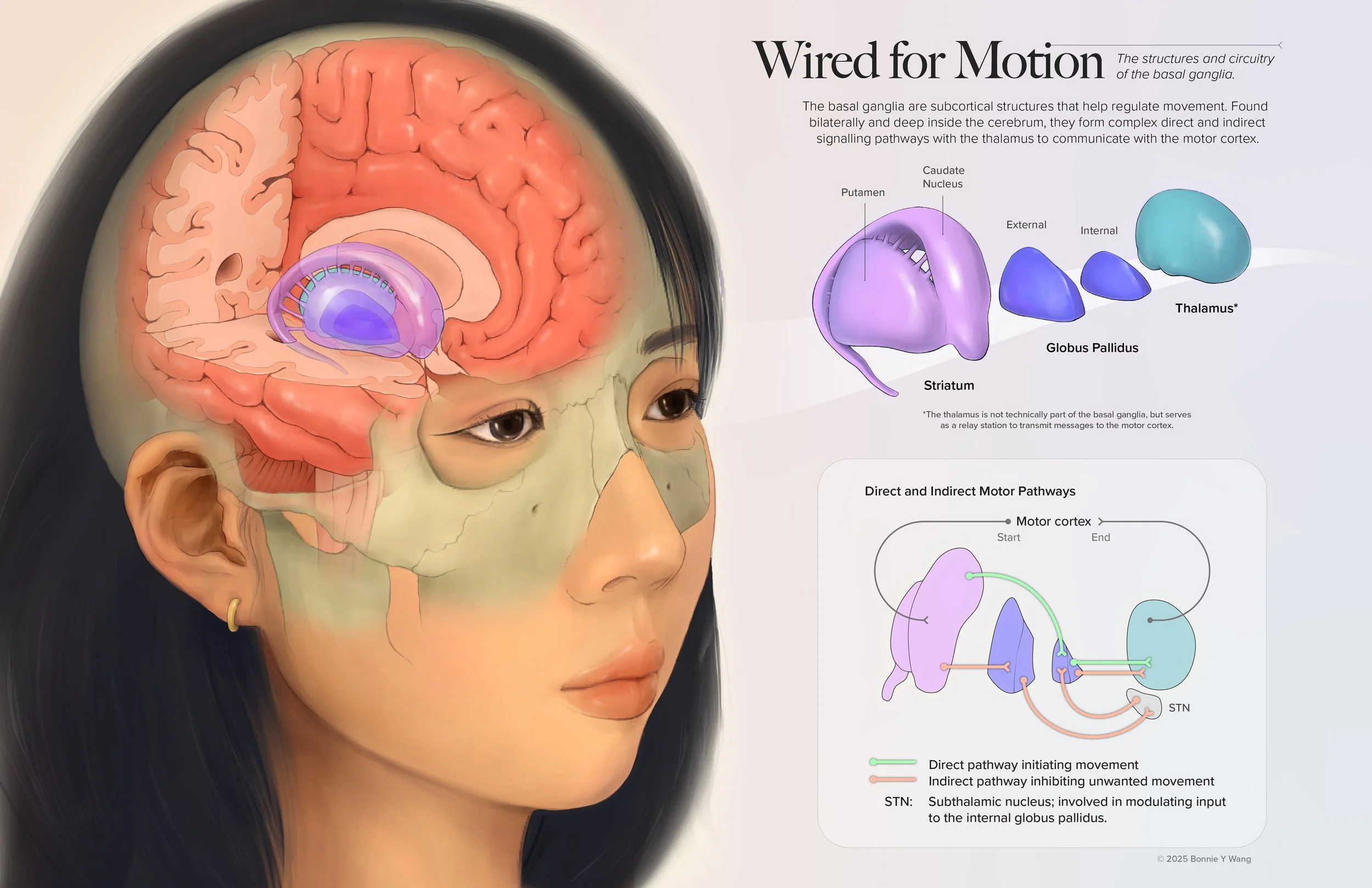
Inspired by my own learning, this project is about the basal ganglia, a set of cortical structures deep in the brain are responsible for motor control. The goal of this piece is to highlight the different structures of the basal ganglia and communicate it’s spatial and functional relationships to an educated lay audience.
Jump to a specific section:
Roles
Research, Illustration, Layout Design
Format/Platform
Print
Tools
Figma, Zbrush, Blender, Procreate, Adobe Illustrator
Client
Dr. Shelley Wall @ University of Toronto
Audience
Educated lay audience
Timeline
October 2024 - December 2024
The design process
Research and ideation.
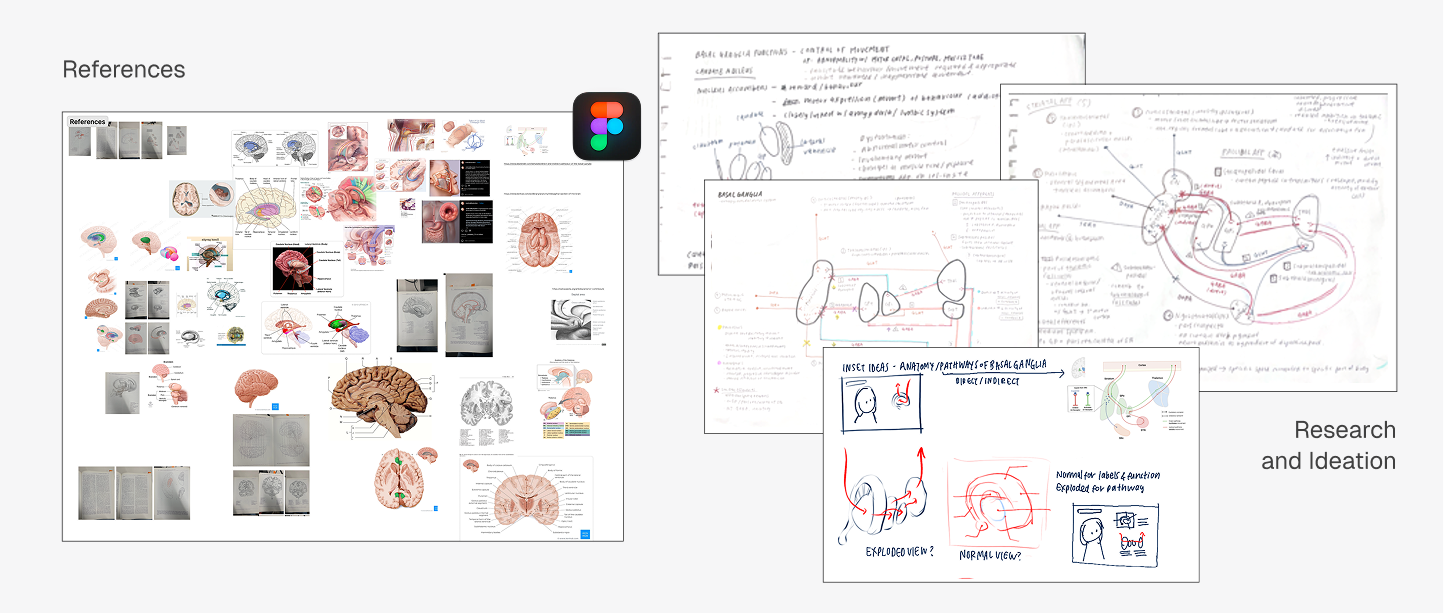
I compiled visual and text references from textbooks, anatomy atlases, and online resources, noting elements I liked and what I thought could be improved.
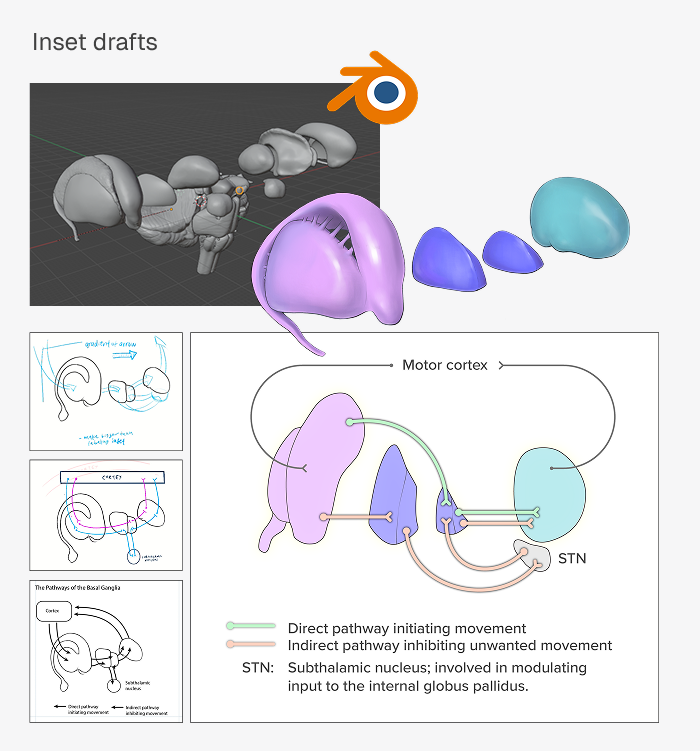
I sketched out different visualizations to see which would be best for understanding. At this point I also created thumbnails to start generating ideas for layout.
Design process.
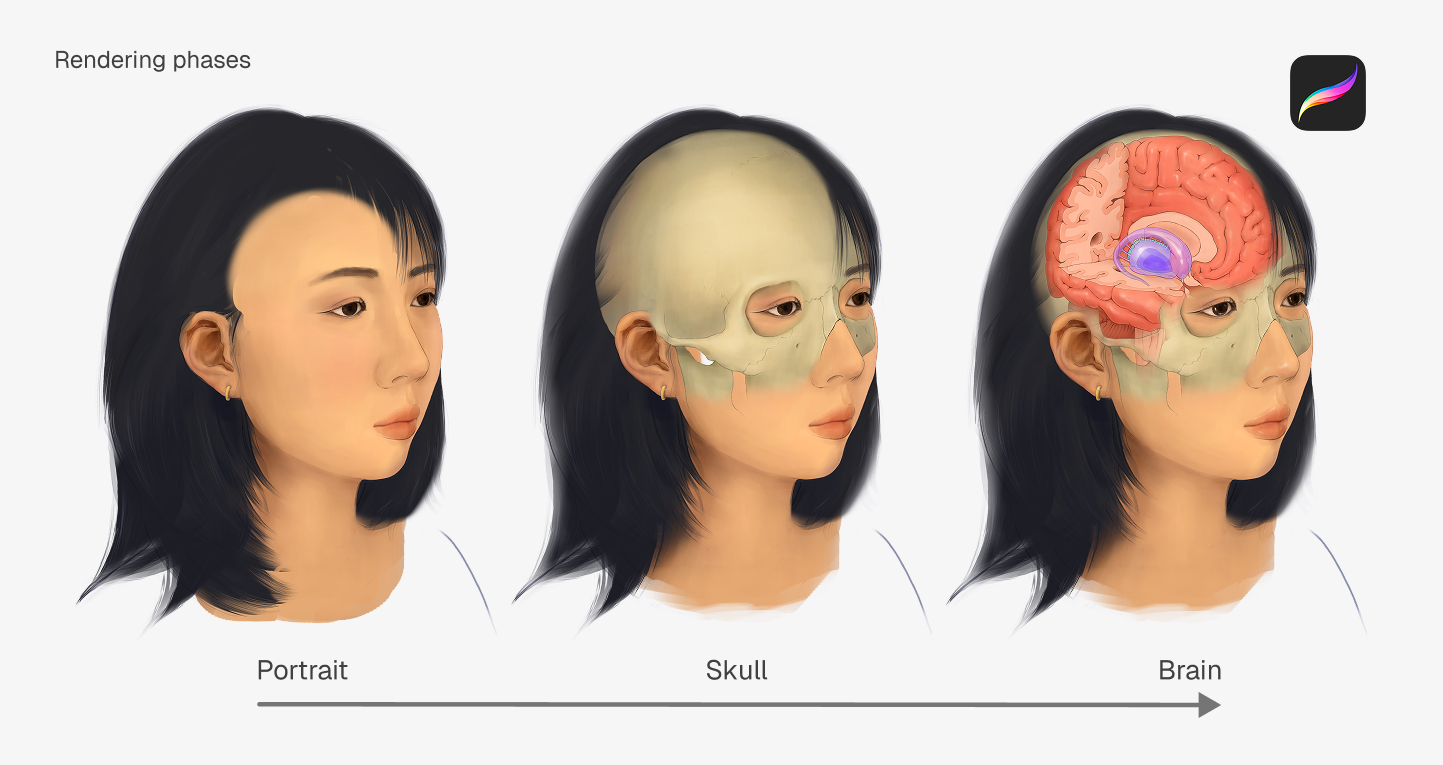
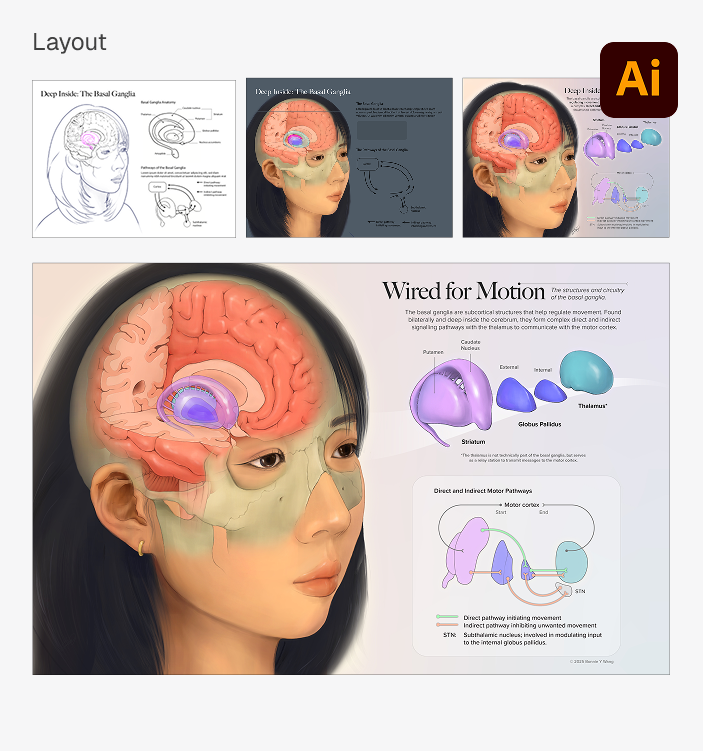
The design challenges and solutions
I. Variation in basal ganglia visualizations and level of detail in structures to include.
E.g., The amygdala is often labelled in diagrams referencing the basal ganglia, despite not actually play a significant role in regulating movement.
II. How can I represent complicated signalling pathways clearly?
In early drafts, all pathways were included in the visualization, which felt overwhelming and required further text explanation.
III. How can structural and functional relationships be linked together through a set of visualizations?
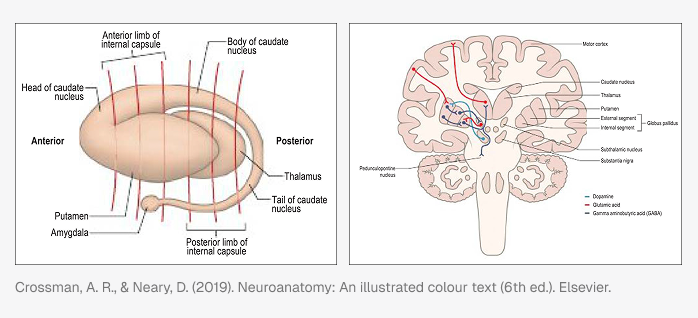
E.g., Below are two diagrams from the same textbook, showing the structural relationships of the basal ganglia on the left, and functional motor pathways on the right. As a learner, it is difficult to relate one to the other because of the different perspectives.
I consulted several, most up-to-date resources as to which structures are considered part of the basal ganglia and did further research.
Structures that are not a part of the basal ganglia but are important in its pathways are explicitly identified to avoid confusion.
I re-aligned with the project objective: to provide an overview rather than a comprehensive understanding of the basal ganglia. Pathways were simplified to only the most essential for understanding.
I also simplified the pathway inset to a 2D schematic rather than the 3D exploded view to reduce the cognitive load and allow the user to focus on the pathways rather than the structures.
I used colour to create another level of categorization. This was kept consistent across all representations to reduce cognitive load and allow for associations to be made.